

Ex p control cabinets for electrochemical synthesis
Explosion protection for an innovative electrolysis process at Boehringer Ingelheim Pharma
Electric current isn't just for powering cars: Electrochemical processes unlock new possibilities for selective synthesis in the production of medication, too. But there are significant explosion risks where electric current, hydrogen and organic solvents come together. This is a case for R. STAHL's explosion protection experts, who developed two mobile Ex p protective enclosures for the electrolysers and the power supply to them.
Intoduction
Electrochemical synthesis is currently experiencing somewhat of a renaissance. Driven by the need for sustainable processes, the chemical industry is increasingly focusing on the use of electric current as an eco-friendly reagent. In the development of medication, electro-organic chemistry offers new options for selective synthesis. But there are significant explosion risks where electric current, hydrogen and organic solvents come together. This means that researchers and engineers are faced with the challenge of how to safely carry out an electrochemical reaction in hazardous areas.
R. STAHL worked closely with Boehringer Ingelheim to come up with a bespoke solution: Two mobile Ex p protective enclosures make it possible to safely use ten powerful electrolysers and a high-current power supply unit in hazardous areas.
Initial situation: Why electrochemistry?
The HAVANA research project, which is part of the publicly funded future cluster "ETOS", is dedicated to further developing Hofmann degradation (a chemical rearrangement reaction) by means of an electrochemical process. This reaction produces isocyanate as a reaction intermediate. Amines – which are difficult to produce – are made accessible through hydration and cleavage of carbon dioxide. In the absence of moisture and with the addition of alcohols, carbamates are produced, as are sulphonylureas when sulphonamides are used. These reactions can also take place within a single molecule, forming complex ring structures (heterocyclic compounds). This is a more environmentally friendly and efficient way of producing these important molecules. The main objective is to replace the highly toxic bromine that has been used so far with sodium bromide, which is much less hazardous, by means of electrochemical production in the reaction system itself.
The bromine required for Hofmann degradation is therefore only generated from bromide in situ at the anode (oxidation reaction). This substitution makes it possible to largely prevent sources of hazards associated with transport, storage and the use of bromine. Since the required bromine is continuously regenerated electrochemically, the process can begin with a far lower initial concentration of bromide. The bromine that is generated is continuously reduced to bromide throughout the course of the reaction. This is a closed cycle with double the safety benefits. What's more, this procedure makes it possible to eliminate many unwanted side reactions and side products. This is because well-controlled and constant process conditions can be ensured through the continuous operation of the reaction and the system layout itself. The result is a far safer and more environmentally friendly method of synthesis.
Challenge: Electrolysis in hazardous areas
Boehringer Ingelheim encountered unique safety-related challenges when it came to carrying out this electrochemical reaction. On the one hand, combustible solvent vapours can escape in the event of a leak, as the reaction medium consists of organic solvents. On the other hand, hydrogen gas is also formed as a waste product during electrolysis at the cathode (reduction reaction). This combination is a classic example of a potentially explosive environment. This is because hydrogen, with an extremely wide explosive range from 4 to 77 per cent by volume and an extremely low ignition energy of around just 0.02 millijoules, is one of the most hazardous substances in explosion group IIC. Even a tiny leak is all it takes to create an ignitable atmosphere in an enclosed space. At the same time, electrical components like the power supply unit, electrolytic cells, sensors and control system are potential sources of ignition – whether because they produce sparks or because they have hot surfaces.
Boehringer Ingelheim was planning to use the trial setup in an area partially classified as Ex Zone 1 – meaning an environment in which explosive atmospheres can occasionally occur during normal operation. To resolve this conflict between electric current and chemicals in hazardous areas, a comprehensive explosion protection concept had to be developed. The objectives were to prevent ignitable atmospheres (primary explosion protection) and sources of ignition (secondary explosion protection).
Mobile cabinets designed with Ex p protection
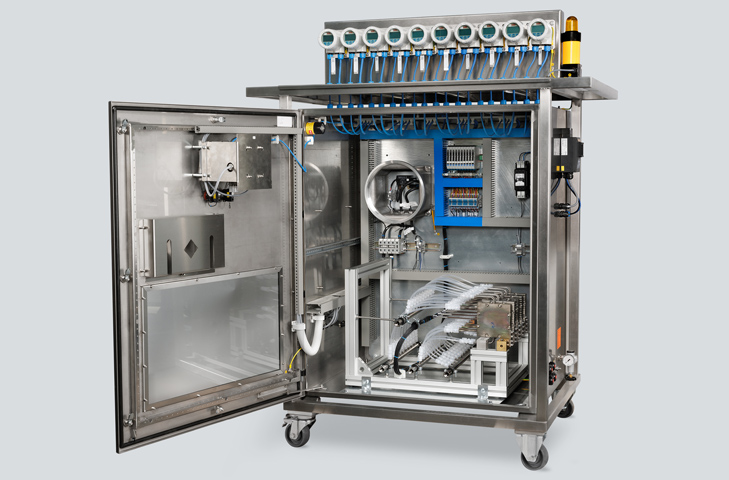
R. STAHL came up with two mobile cabinets with Ex p protection. The first trolley contains the ten electrolysers developed during the HAVANA project, each with an integrated heat exchanger and consisting of five two-compartment electrolytic cells connected in parallel. The solution that was chosen combines two tried-and-tested protective principles: Nitrogen inertisation and pressurised enclosure (Ex p). This involves keeping the inside of the enclosure at a slightly higher pressure compared to the environment, preventing the ingress of ignitable gases or vapours. Before being commissioned, the enclosure is purged with nitrogen to remove any remaining oxygen or solvent vapours.
Hydrogen was a particular focus. Due to its diffusion properties, this tiny molecule can even escape through seals, which over time could have led to a not insignificant concentration in an sealed enclosure. Without suitable encapsulation, this couldn't be measured or simulated beforehand. This is why a gas warning device has been installed as an additional safety feature. This can be used outside hazardous areas in non-inert pilot operation on a laboratory scale. A sensor continuously monitors the gas composition inside. If the lower explosive limit (LEL) is exceeded, the system is automatically shut down and a built-in flashing beacon triggers a visual alarm. And that's not all – ten temperature measuring points with digital displays built into the electrolysers make it possible to monitor the process with precision. An inspection glass also makes direct visual checks possible.
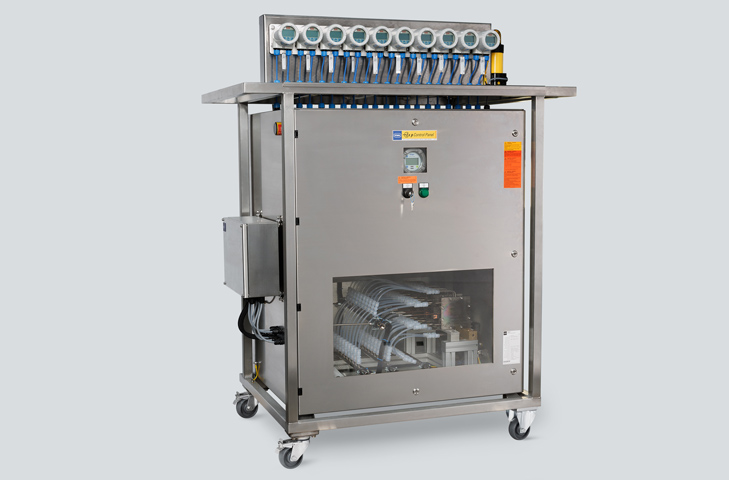
The second trolley includes a high-current power supply unit, which provides up to 120 A of direct current. The output voltage and electric current are controlled by two potentiometers, with the addition of a key-operated switch. This means that final step of enabling the voltage only happens when the safety logic is activated.
Both cabinets are designed for use in Ex Zone 1 and meet the requirements of gas group IIC, which includes hydrogen. Almost all of the components inside the cabinets have an explosion-protected design (Ex d/Ex e) – from temperature sensors and pressure monitors through to terminal strips. The enabling relay has been integrated into a flameproof Ex d enclosure which reliably contains flames in the event of sparking or arcing. Gas-tight sealing inserts (MCT) and Ex-certified screw connections with strain relief were used for the cable routing.
The mobile design makes it possible to flexibly position the units in the laboratory – even outside classified Ex Zones. Trial setups can be tested in bypass operation without the protection being compromised. The logic of the enabling chain ensures that voltage is only activated when the purging is correct, the gas alarm is negative and the key-operated switch is activated.
This project was carried out with close cooperation between Boehringer Ingelheim, the Technical Sales department and the development team at R. STAHL. By involving the customer at an early stage and communicating transparently with them, it was easy to integrate their requests, such as an additional inspection glass or hydrogen sensor, even if they were made at a later point.
New synthesis and electrolysis methods are possible
The Ex p solution makes it possible for Boehringer Ingelheim to safely carry out electrochemical processes with high current density on a pilot-plant scale for the first time. This paves the way for new synthesis methods which are not only more sustainable, but safer too. The explosion protection concept that was chosen can, in principle, also be applied to other electrochemical systems.
Conclusion: Explosion protection makes the new process manageable
This project clearly demonstrates how state-of-the-art safety technology can unlock innovation in chemistry. The combination of pressurised enclosure, gas monitoring and intelligent control means that even hazardous processes can be managed.
For further information on electrochemistry, see the references:
D. Nater, R. Zhao, J. Rocker, C. Boche, D. Yun, B. Werner, P. Löb, A. Ziogas, S. R. Waldvogel, Hectogram-Scale Synthesis of Carbamates using Electrochemical Hofmann Rearrangement in Flow, Org. Process Res. Dev. 2025, 29, 2370–2377. [DOI: 10.1021/acs.oprd.5c00234].
D. F. Nater, P. Hendriks, S. R. Waldvogel, Electrochemical Hofmann Rearrangement at High Current Densities in a Simple Flow Setup, Mol. Catal., 2024, 554, 113823. [DOI: 10.1016/j.mcat.2024.113823]